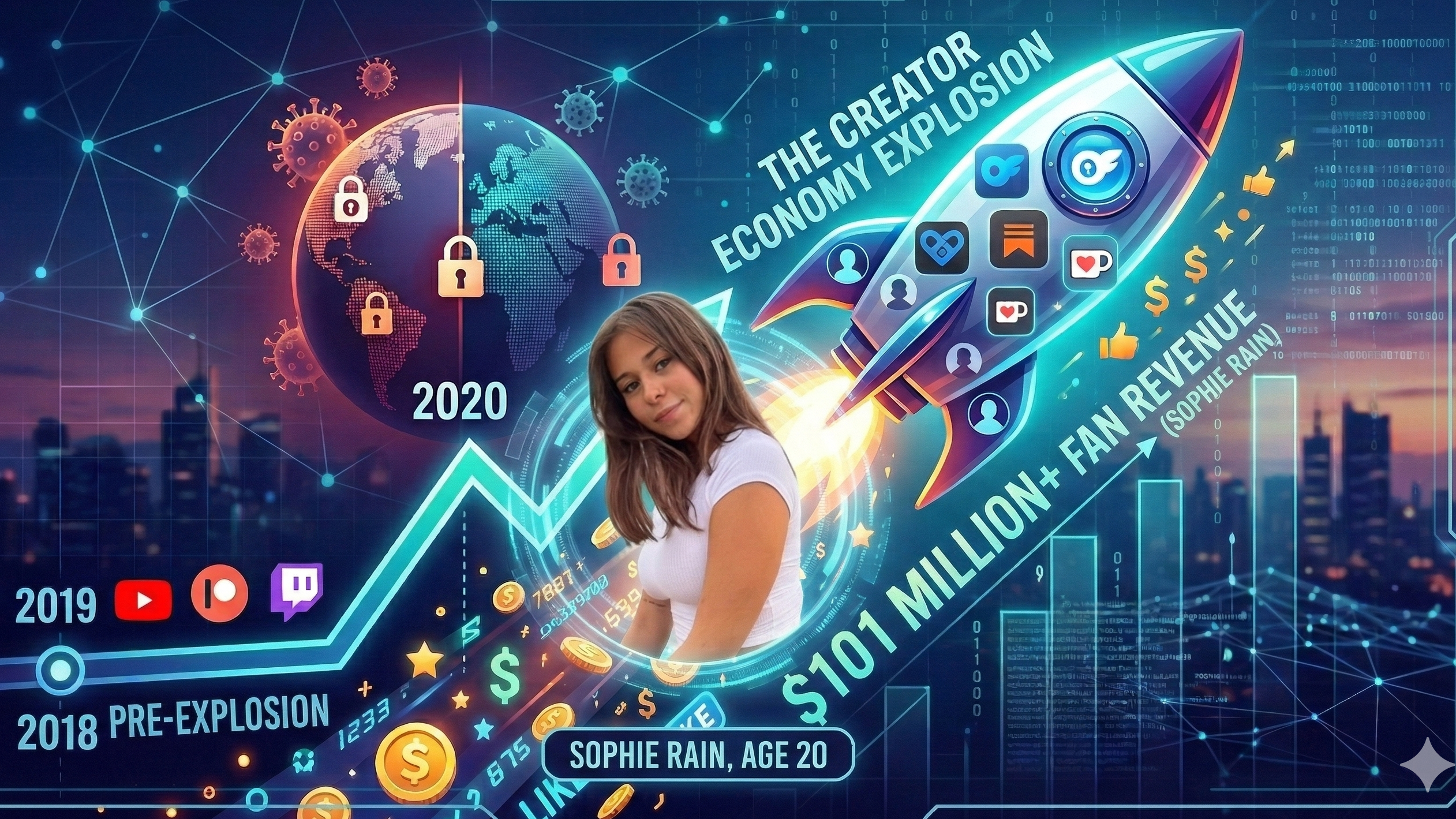
A global pandemic shut down the world. It also accidentally launched one of the most powerful economic shifts for independent creators in history.
The Before Times
Pre-2020, the creator economy was already growing — YouTube ad revenue, Patreon subscriptions, Twitch donations. But the real money still largely flowed through traditional gatekeepers: record labels, talent agencies, studios, publishers. If you wanted to make a living as a creative person, you generally needed someone else's permission.
Then the world locked down.
Covid Changed Everything
With live events canceled, traditional income streams for entertainers evaporated overnight. At the same time, people stuck at home were hungrier than ever for connection, entertainment, and parasocial relationships with people they admired.
OnlyFans — already 3 years old at the time — became a cultural phenomenon almost overnight.
The numbers tell the story:
- 2019: ~120,000 creators on OnlyFans
- 2020: That number exploded to over 1 million creators
- 2023: 4+ million creators, 220+ million registered users
- Total payouts to creators: Over $15 billion since inception
OnlyFans wasn't alone. Patreon, Fansly, Fanvue, Ko-fi, Substack, and dozens of niche platforms saw similar surges. The infrastructure for creator-owned monetization had been building for years — Covid just poured rocket fuel on it.
The $101 Million Creator: Sophie Rain and the New Creator Elite
Here's a number that's hard to wrap your head around: $101,209,778.
That's the reported all-time earnings of Sophie Rain — a creator who built her audience largely through social media and fan subscription platforms. She's 20 years old.
To put that in perspective:
- The average American will earn roughly $1.7 million over their entire lifetime
- Sophie Rain has earned 60x that — before turning 21
- She did it without a record label, a studio deal, or a talent agency
She's not an outlier in the sense that she got lucky. She's an outlier in scale — but the model she used is being replicated by tens of thousands of creators at every income level.
How the Economics Actually Work
Fan platforms operate on a surprisingly simple model — and that simplicity is exactly what makes them powerful.
Direct-to-Fan Monetization
Instead of earning fractions of a cent per stream or fighting for YouTube CPM rates, creators charge subscribers directly. A creator with 10,000 subscribers at $10/month earns $100,000/month — before tips, pay-per-view content, or custom requests.
The Platform Cut
Most fan platforms take 20% of creator earnings. That's steep compared to, say, Etsy (6.5%) — but compared to a record label taking 80%+ of artist revenue, it's a revolution.
The Long Tail Is Real
The headline-grabbing numbers belong to creators like Sophie Rain, but the real story is in the middle:
- Creators earning $1,000–$10,000/month number in the hundreds of thousands
- For many, this replaces or supplements a full-time income
- Geographic arbitrage is real — a creator in Southeast Asia or Eastern Europe earning $3,000/month is living extremely well
It's Not Just Adult Content
A persistent misconception is that fan platforms are synonymous with adult content. The reality is far broader:
- Fitness coaches selling personalized workout plans and form checks
- Musicians offering early access, stems, and personal voice messages
- Writers and journalists (Substack alone has paid out over $300 million to writers)
- Chefs sharing recipes and live cooking sessions
- Gamers and streamers monetizing beyond Twitch's revenue share
- Therapists and coaches offering community-based mental health support
The common thread isn't the content type — it's the direct relationship between creator and audience, with no algorithm deciding who sees what.
Taking Control of the Audience: Why Ownership Matters
This is the part that gets undersold in most coverage of the creator economy.
When you build an audience on Instagram, TikTok, or YouTube, you don't own that audience. The platform does. Your reach can be throttled, your account can be suspended, and an algorithm change can slash your income overnight — and there's nothing you can do about it.
Fan platforms flip this. When someone subscribes to your OnlyFans, Patreon, or Fansly:
- You have their payment relationship — not the platform
- You can message them directly — no feed algorithm
- You know who your real fans are — the ones willing to pay
Smart creators treat fan platforms as their economic foundation and social media as the top of their funnel. Build on rented land (social), but earn on owned land (subscriptions).
The Risks Creators Need to Know
The fan site economy isn't without its pitfalls.
Platform risk is real. OnlyFans famously announced (then reversed) a plan to ban adult content in 2021 — overnight panic for creators who had built their entire business there. Diversification across platforms matters.
Content theft is rampant. Subscription content gets leaked, screenshotted, and redistributed constantly. This is why copyright protection — DMCA monitoring, takedown automation, watermarking — has become an essential part of the creator business stack, not an afterthought.
Burnout is an industry-wide problem. The parasocial economy rewards constant availability. Creators who don't set boundaries often pay for it with their mental health.
Tax and financial literacy gaps. Many creators — especially those who scale quickly — are unprepared for self-employment taxes, quarterly payments, and business formation. Getting this right early makes a massive difference.
What This Means for Aspiring Creators
If you've been sitting on the fence about monetizing your audience directly, here's the honest truth: the infrastructure has never been better, the audience appetite has never been higher, and the barrier to entry has never been lower.
You don't need a million followers. You need 1,000 true fans — a concept creator economy theorist Kevin Kelly articulated back in 2008, and that the last five years have thoroughly validated.
1,000 fans paying $10/month = $120,000/year. That's a livable income for most creators, in most places in the world.
The question isn't whether the creator economy is real. Sophie Rain's nine-figure earnings are proof it is. The question is what you're going to do about it.
The Platforms Worth Knowing
| Platform | Best For | Creator Take |
|---|---|---|
| OnlyFans | Adult & lifestyle creators | 80% |
| Patreon | Artists, podcasters, writers | ~88–95% |
| Fansly | Adult content, OnlyFans alternative | 80% |
| Substack | Writers & journalists | 90% |
| Ko-fi | Casual supporters, digital products | 95%+ |
| Fanvue | Emerging OnlyFans competitor | 85% |
| Fourthwall | Merch + memberships | 97%+ |
Final Thought
The pandemic didn't create the creator economy — but it stripped away every excuse not to participate in it. When the traditional structures fell away, millions of creators discovered they didn't need them.
Sophie Rain didn't earn $101 million because she had a label, a manager, or a studio. She earned it because she built a direct relationship with an audience willing to pay for what she creates.
That playbook is available to anyone.
Thinking about launching your own fan platform or protecting the content you've already built? Drop a comment or get in touch — we cover the creator economy in depth every week.