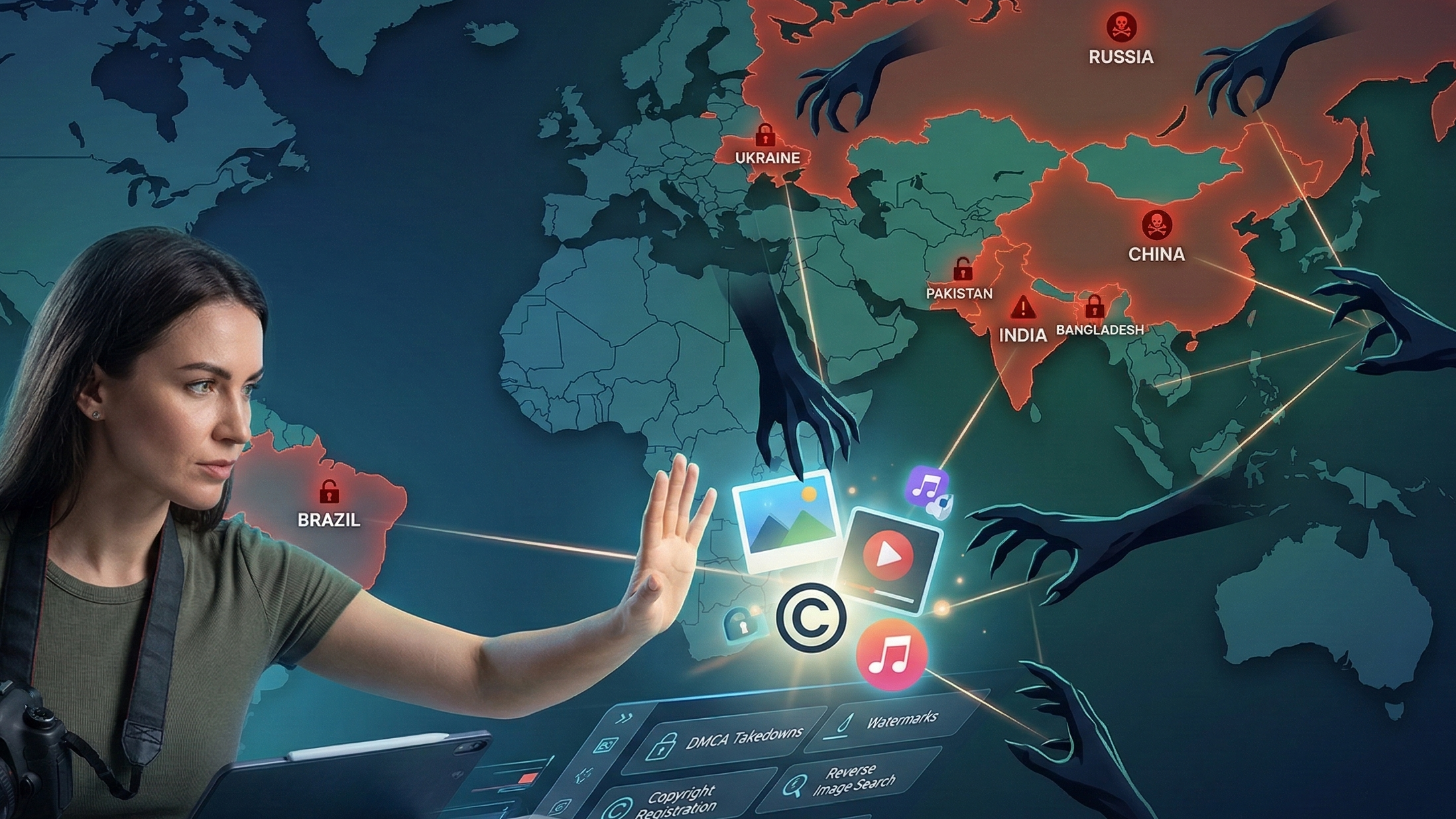
If your content is being stolen, it might not be an accident. Some countries make it alarmingly easy.
Why Geography Matters in Copyright Law
Copyright protection isn't universal. While most countries are signatories to the Berne Convention — an international treaty that establishes baseline protections for creative works — enforcement varies wildly. In some regions, weak laws, corrupt legal systems, or deliberate policy choices make copyright infringement not just common, but practically consequence-free.
For content creators — photographers, videographers, musicians, writers, designers, and OnlyFans/Patreon creators — understanding where your content is most vulnerable is the first step to protecting it.
Countries Known for Weak Copyright Enforcement
🇨🇳 China
China has copyright laws on the books, but enforcement is notoriously inconsistent. Piracy websites, counterfeit goods marketplaces, and stolen digital content thrive across Chinese hosting networks. Many infringing sites operate from Chinese servers specifically because takedown requests are frequently ignored or delayed by months.
What creators face: Stolen videos, music, photography, and software redistributed on Chinese platforms with little recourse.
🇷🇺 Russia
Russia has long been a haven for piracy infrastructure. Sites like the now-defunct Sci-Hub and numerous torrent platforms have historically operated from Russian servers. While Russia is technically a Berne Convention signatory, political dynamics — especially post-2022 — have further reduced cooperation with Western IP enforcement efforts.
What creators face: Content hosted on Russian CDNs or mirror sites with no meaningful path to removal.
🇺🇦 Ukraine
Before the 2022 invasion, Ukraine was frequently cited by the U.S. Trade Representative on its "Priority Watch List" for IP violations. Piracy platforms including some major streaming and software sites operated openly. The ongoing conflict has made enforcement infrastructure even more fragmented.
What creators face: Streaming piracy and content redistribution with limited government resources to address complaints.
🇧🇷 Brazil
Brazil has a large, tech-savvy population and a significant piracy culture. While Brazilian law does protect copyright, enforcement is slow and lawsuits are expensive. Many infringing sites operate locally and are difficult to reach through standard DMCA processes (which only apply in the U.S.).
What creators face: Content stolen and redistributed on Brazilian social media and local hosting platforms.
🇮🇳 India
India has robust copyright statutes, but enforcement capacity doesn't match the scale of infringement. Bollywood piracy is well-documented, but foreign creators are also affected — particularly photographers and video creators whose work gets reposted without credit or compensation across Indian social platforms.
What creators face: Mass reposting on regional platforms where takedowns are slow and inconsistent.
🇵🇰 Pakistan / 🇧🇩 Bangladesh
Both countries appear regularly on international IP watchlists. Enforcement infrastructure is limited, and many infringing websites are hosted locally or in jurisdictions that ignore foreign takedown requests.
Offshore and "Bullet-Proof" Hosting Jurisdictions
Beyond individual countries, watch out for hosting providers that specifically market themselves as "bullet-proof" — meaning they will not comply with DMCA or legal takedown requests. These are often located in:
- Moldova
- Seychelles
- Panama
- Netherlands (some providers, despite strong EU laws)
These hosts are deliberately chosen by piracy sites and leaked content distributors precisely because they resist pressure.
How to Protect Yourself as a Content Creator
1. Register Your Copyright (Where Applicable)
In the United States, registering your work with the U.S. Copyright Office gives you the ability to sue for statutory damages — up to $150,000 per willful infringement. Without registration, you're limited to actual damages, which are often impossible to prove.
Action: Register at copyright.gov for as little as $45 per work.
2. Watermark Your Content Strategically
Visible watermarks deter casual theft. More importantly, metadata watermarks (invisible, embedded in the file) can survive screenshots and re-uploads and help you prove ownership in disputes.
Tools: Digimarc, Imatag, or simple metadata embedding via Adobe Bridge/Lightroom.
3. Use Reverse Image & Video Search
Regularly search for your content across the web to catch infringement early.
Tools:
- Google Reverse Image Search — drag and drop your image
- TinEye — specialized reverse image engine
- YouTube Content ID — automatically matches your video content
- DMCA.com — paid monitoring service for creators
4. Send DMCA Takedown Notices
The Digital Millennium Copyright Act (DMCA) applies to platforms operating in or serving U.S. users, regardless of where they're hosted. Most major platforms (Google, Meta, YouTube, Reddit, Twitter/X) have DMCA submission portals.
Key platforms:
- Google Search: reportcontent.google.com
- Meta/Instagram: Through their IP reporting tool
- YouTube: Via the Content ID or Copyright Removal form
Even if a site is hosted overseas, you can request Google de-index the infringing URLs — cutting off the traffic pipeline.
5. Use Automated DMCA Services
For creators with high content output (or adult content creators dealing with leaked material), manual takedowns don't scale. Automated services scan the web and fire off takedowns on your behalf.
Services to consider:
- DMCA.com — monitoring + takedown automation
- Pixsy — specialized for photographers
- Creator Defense (emerging) — scanning and automated DMCA for digital creators
- Takedown Piracy — broad piracy monitoring
6. Build a Paper Trail of Ownership
Save original files with intact metadata. Use cloud storage with timestamped backups. If you ever need to prove you created something first, timestamps matter.
Best practice: Store RAW files, project files, and drafts — not just final exports.
7. Include Copyright Notices Everywhere
A visible © [Year] [Your Name]. All Rights Reserved. on your website, in video descriptions, and in document footers signals that you're actively protecting your work and aware of your rights.
8. Know When to Hire a Lawyer
For large-scale infringement — especially if someone is profiting from your stolen work — consult an IP attorney. In the U.S., if your work is registered, you may be able to recover attorney's fees in addition to damages, making cases more attractive to attorneys working on contingency.
Quick Reference: Creator Protection Checklist
| Action | Cost | Impact |
|---|---|---|
| Register copyright (US) | $45+ | High — enables statutory damages |
| Watermark content | Free–$30/mo | Medium — deters & helps prove ownership |
| Set up reverse image alerts | Free | High — catches infringement early |
| File DMCA takedowns | Free | High — removes content from indexed platforms |
| Use automated monitoring | $20–$200/mo | Very High — scales protection |
| Consult an IP attorney | Varies | Essential for serious cases |
Final Thoughts
Copyright infringement isn't going away — if anything, the proliferation of AI-generated reposts, scraping tools, and bullet-proof hosting has made it easier than ever for bad actors to steal creative work. The countries and hosting environments listed above are known weak points, but infringement can happen anywhere.
The good news: creators who are proactive — who register their work, monitor the web, and file takedowns consistently — win the vast majority of their cases. Most infringers are counting on you not noticing, or not bothering.
Notice. Bother.
Have you had your content stolen? Reach out to at creator defense, we can help.